Triskaidekaphobia and Other Noir Tales
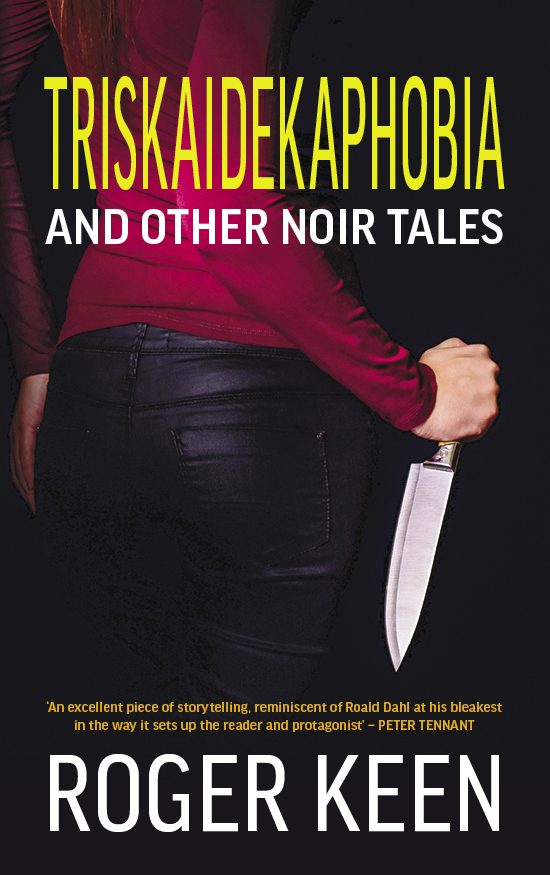 Like many of my other book projects, this short story collection was a long time in the making. As I say in the introduction, the stories were written in the 1990s and form a body of work concerning my literary leanings back then, so they all hang together as a piece. Being written and set in the past hasn’t blunted their preoccupations, in my own opinion, because the themes are as relevant now as ever.
The title, Triskaidekaphobia, was always earmarked as thus, because it’s such a great word, and one-word titles have a certain unique impact – especially within the horror genre. It grew to Triskaidekaphobia and Other Noir Tales, and recently I adopted a lengthy descriptive subtitle: Unsettling Stories of Dark Psychology, Amorous Transgression and Wry Humour, in order to readily advertise the content from a page or thumbnail on a retail site, as so many books do nowadays.
The stories range from those with distinctly ‘horror’ elements – several originally published in 1990s indie press magazines such as Sierra Heaven, Psychotrope, Threads and Flickers ‘n’ Frames – to more literary pieces, some with borderline fantasy themes and others set in quotidian British life, but with lurking dark or noir elements.
Looking back over influences, real-life and fictional, I see that the John and Lorena Bobbitt case happened almost exactly thirty years ago now, becoming a huge tabloid sensation and also generating an undercurrent of comic pathos to accompany the extreme violence, of a kind congruent with one’s worst – and archetypally Freudian – nightmares. The Ian McEwan short story ‘Pornography’, from the collection First Love, Last Rites, also resonates; and the whole métier of those stories from the ‘Ian Macabre’ period was a guiding light.
Continuing the ‘amorous transgression’ thread, the dirty phone call inclusion was based on a real dirty phone call, related to me by a female friend, who reckoned she knew the perpetrator, and was probably correct in that assumption. Road-rage was another big preoccupation of the ’90s zeitgeist, and I cannot forget a certain incident, when I turned off the M4 at the M32 junction, and I saw two cars parked up on the grass verge, their drivers engaged in a full-on fist fight, swinging haymakers at one another.
Designer oblivion is another theme, not through drugs this time – though there is one sequence of ‘temporary cannabis psychosis’ – but through deep dreaming, and through snow…Snow…? Yes, snow. As a skier, I’ve experienced this once or twice, and polar explorers and frequenters of artic regions must know it well…Lightness visible, perhaps.
Triskaidekaphobia is published today, in paperback and Kindle worldwide. For more information and purchase links, please visit: Darkness Visible Publishing
LSD, Smiles and the Madness of Operation Julie

Alston Hughes, aka ‘Smiles’, at the time of trial for dealing massive quantities of LSD
The story of ‘Operation Julie and the Microdot Gang’ has become part of hippy folklore, a ‘cops ’n’ outlaws’ clash to rival the Sheriff of Nottingham and Robin Hood’s Merry Men, or Joe Lefors and Butch Cassidy’s Wild Bunch. Many books have been written about it from the perspective of both sides of the law – from Inspector Dick Lee’s account to Leaf Fielding’s.
Now In Search of Smiles, a new biography of Alston Hughes, a key figure in the Microdot Gang (written by LSD historian Andy Roberts), has been published by Psychedelic Press. Here is my extended feature on the book and the Operation Julie phenomenon:
The term ‘Operation Julie’ is indelibly branded on the minds of anyone who knows anything about British counterculture in the 1970s. One of the biggest anti-drugs initiatives ever, it was tabloid heaven, with the bust itself, in March 1977, becoming the top news story of the day, its ramifications going far and deep.
In the public mind, drug busts were directed against familiar hard drugs such as heroin and cocaine, and increasingly cannabis, the smuggling and distribution of which had increased exponentially over the past decade. What made Operation Julie newsworthy was the target drug, LSD, at the time an exotic and much-feared substance; known to have inspired the Beatles and Pink Floyd, but also to have driven people crazy.
Therefore, the dynamics of Operation Julie were qualitatively different. The story wasn’t about a straightforward ‘good cops versus evil pushers in it for the money’, it was about ideology and the politics of personal experience, about LSD’s effect on society, and controlling the impressionable. LSD proponents, people who’d experienced the drug in significant doses, and who had undergone its transcendental, transformative effects, saw it as a catalyst to change the world for the better, a shortcut to ‘the meaning of life’, which, if it were to spread exponentially throughout the populace, would effect desirable societal change, one brain at a time…
Read more on Psychedelic Press Substack
Man of Letters: Psychedelic Writings

Out Now: A collection of fourteen psychedelic-themed essays, several of which have appeared in Psychedelic Press, The Oak Tree Review and Reality Sandwich, covering countercultural history, avant-garde and psychedelic cinema, and the psychology of altered states. They touch on figures such as Thomas DeQuincey, Charles Baudelaire and William Burroughs; and in the field of cinema, directors including Ken Russell, Roger Corman, David Cronenberg, Terry Gilliam and Ben Wheatley are explored.
The essays revisit the ‘Alphabet Wood’ hallucination of the Plym Woods in 1975, the mushroom-inspired ‘Cult of the Novel’ messianic quest to turn the world on to ‘reality fiction’, and contain updates to the ‘trippy movie’ coverage, including 2022 films Avatar: The Way of Water and Doctor Strange in the Multiverse of Madness.
The alphabetic cover comes with its own story, dating back to my ‘Strange Days’ of the mid-1970s in Bournemouth, and stretching into the realms of contemporary horror and fantasy cover design. Read the full story on Medium: A Tale of Two Covers
Further details regarding Man of Letters, and purchase links can be found here: DV Publishing
AI Images by Des Lewis from The Empty Chair and Literary Stalker
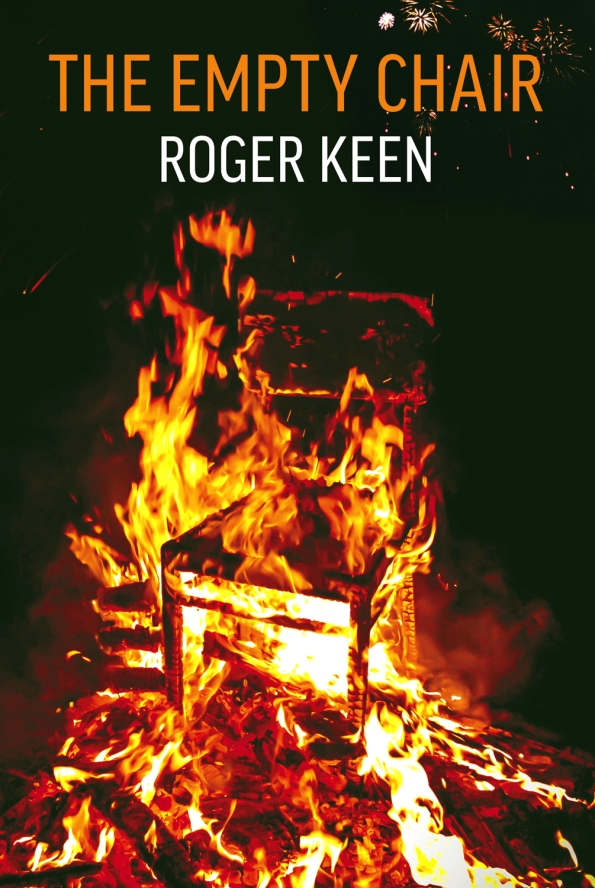
As a compliment to his unique real-time reviews, Des Lewis has been experimenting with AI imagery related to reviewed material, the results of which are as weird as Freud’s dreams projected onto Salvador Dali’s landscapes. Des was kind enough to create some images drawn from my novels The Empty Chair and Literary Stalker…
The assemblage of Empty Chairs, some of them on lonely film sets, ominous equivocal father figures, shadowy stalkers in libraries, Singing Detectives and nightmarish tentaculate silhouettes brings it all back…the writing and the source material…

Some AI visual experiments triggered by my reviews of Roger Keen, reviews linked here: https://dflewisreviews.wordpress.com/2021/04/05/literary-stalker/ and https://dflewisreviews.wordpress.com/2021/08/29/the-empty-chair-roger-keen/
Avatar: The Way of Cliché
Thoughts on Avatar: The Way of Water, done with reference to my ‘Psychedelia in the Movies’ strand, revisited and updated in the soon-to-be-published collection Man of Letters…
The 2009 film’s innovative Fusion Camera System 3D was enchanting in a notably ‘psychedelic’ way, but does the sequel build on this trend…?

In December 2022 a long-awaited moment finally arrived: the cinema release of the first of four projected sequels to the ground-breaking 3D blockbuster Avatar, after a thirteen-year gestation period. Within the psychedelic community Avatar was noted for a having a distinct trippy quality, albeit an ambient one, which made it comparable to movies such as Stanley Kubrick’s 2001: A Space Odyssey and Alejandro Jodorowsky’s The Holy Mountain, which caried the tropes but didn’t feature the actual drugs. As Erik Davis said in his 2010 article ‘Aya Avatar’:
Eco-futuristic dreams are now indistinguishable from the visionary potential of media technology itself. Indeed, whether you are talking form (ground-breaking 3D animation) or content (cyber-hippie wetdream decor), Cameron’s visual and technological rhetoric is impossible to disentangle from hallucinogenic experience.
Indeed Avatar, together with Tim Burton’s Alice in Wonderland – released three months later – seemed to portend a new dawn in ambient psychedelic movies where 3D and state-of-the-art VFX enabled a quasi-altered state within the cinema viewing experience itself… Read More on: Medium
Ian McEwan’s Lessons and The Empty Chair

I very much enjoyed Ian McEwan’s new novel, Lessons – and another dimension to that experience lay in its uncanny similarity to The Empty Chair. This piece explores that common territory and looks back at other concrescences of Ian’s and my work, such as the identical twist endings of The Mad Artist and Sweet Tooth. It also revisits the controversies over similarities between Atonement and Part Three of the wartime nursing memoir No Time for Romance by Lucilla Andrews, and between The Cement Garden and Our Mother’s House by Julian Gloag.
Lessons is Ian McEwan’s best novel since Atonement, a true late major work, perhaps a late masterpiece. He handles an armada of complex interlocking threads with breathtaking aplomb, from broad historical strokes through to microscopic dissections of human emotions and perceptions. Take an early scene in which a detective visits Roland at home, where he is caring for his seven-month-old son after the dubious disappearance of his wife, Allissa. During the conversation — perhaps an interrogation — the baby squawks, demanding attention. And then the infant’s point of view is given, speculatively, in considerable detail:
A shaded emptiness, a grey winter sky against which impressions — sounds, sights, touch — burst like fireworks in arcs and cones of primary colour, instantly forgotten, instantly replaced and forgotten again.
And presently, there’s more speculation on the effect of the mother’s desertion on her young son, the nature of the ‘scar tissue’ it is forming. Reading Lessons, one is constantly aware one is imbibing writing of an exceptionally elevated calibre.
Read more on Medium
The Singing Detective and other BBC Classic Dramas

Bernard Hill as Yosser Hughes in Boys from The Blackstuff
To celebrate its centenary year, the BBC has been airing reruns of many of its best and most-loved classic dramas on BBC Four. My favourites are Boys from The Blackstuff, Our Friends in The North, House of Cards and, of course, The Singing Detective. There is something warm and fuzzy about watching these works, from what has now in the 2020s become a ‘bygone age’. They’re all in colour, yes, but the 4:3 screen ratio, leaving big black side borders on today’s televisions, and the somewhat grainy and not very high resolution 16mm film, lend an archaic atmosphere that is nonetheless counterbalanced by sweet nostalgia.
What has come over from the rewatching, personally, is how much these dramas mean to me and how they have influenced my writing. Take the episode Yosser’s Story in Boys from The Blackstuff, which shows the unemployed and unstable eponymous character in the throes of an existential crisis, leading to him becoming totally unhinged. Bernard Hill’s peerless performance got everything just right – the frustration, the sense of victimhood, the self-pity, and the crazy fulminating anger – so much so that back in 1982 he reminded me all too clearly of my own father, when he got into those kinds of moods.
Four years later, when I commenced my novel about a bad father, The Empty Chair, Yosser became a prototype for various versions of the bad father character, and when the film-within-the-novel develops, it is an older Bernard Hill who is cast to play that screen father.

Michael Gambon in The Singing Detective
Similarly, The Singing Detective, first broadcast in 1986, the very year The Empty Chair narrative commences, became a kind of ongoing parallel story. Its progression through misanthropy, psychosomatic illness, analysis of childhood, psychotherapy and the act of writing itself, mirrored everything in my novel. And when filmmaker Steve Penhaligon reaches the final stages of realising his film about his life, it is The Singing Detective’s mimed song-and-dance routines that unlock his idea to do the same with prog rock – King Crimson’s ‘21st Century Schizoid Man’ and Jethro Tull’s ‘Living in the Past’ to name two of the tracks.
In view of The Singing Detective’s rerun, I have republished a review I did for The Digital Fix from about ten years ago: The Singing Detective: The Triumph of the Invented Self
Will Self and the Drug Memoir
 My article “Will Self and the Drug Memoir” is now available in the new Psychedelic Press journal XXXVII, and an extract is also out on their Substack. The piece focuses on Will Self’s memoir Will – which details his drug use from age seventeen to twenty-five, taking in his years as an Oxford student and concluding with his rehab in Weston-super-Mare – setting this against a brief history of the drug memoir genre and featuring the key works of Thomas De Quincey, Charles Baudelaire, Fitz Hugh Ludlow, Aleister Crowley, William Burroughs and others.
Though Will Self’s memoir mainly concentrates on heroin use and addiction, there are sections on other drugs, including LSD, and my article highlights this and also Self’s psychedelic philosophies.
“In his recent drug memoir, simply entitled Will, Will Self writes about himself in the third person, presumably to gain an extra measure of objectivity in what is necessarily a significant act of self-examination. Early on he says that drugs are neither a hobby nor a genre, but drug memoirs can certainly be considered as such, or at least a category—Amazon lists them under ‘Alcohol & Drug Abuse Biographies’, which includes the usual raft of celebrity confessional tomes, rubbing shoulders with the classics, such as Aldous Huxley’s The Doors of Perception: And Heaven and Hell, which, 68 years after its first publication, still sells well enough to make the top 100.”
Read more on Psychedelic Press Substack
Literary Stalker – Kindle version free for a limited period!
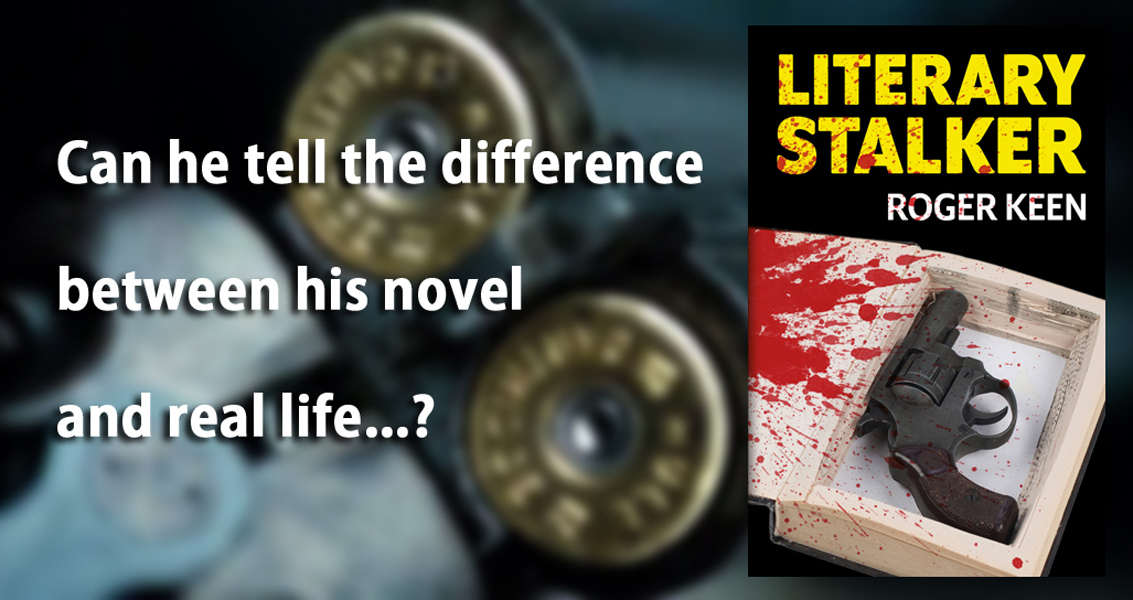
Literary Stalker: The Adventures of Crazed Author Nick and his Alter Ego Jago is set in a skewed version of the British Fantasy and Horror community…No writers, editors or critics were harmed in the making of this novel…Honestly!
What the real critics said:
Des Lewis: “It seeps with real threat disguised within playfully literary semantic syntax, as well as hilarity, filmic and horror-literary references galore. Bi-sex and bi-genre.”
Simon Clark: “Suspenseful, impeccably researched, grisly, with judicious helpings of macabre humour, I relished this ‘Russian doll’ story-within-a-story.”
Noel Megahey: “Literary Stalker works wonderfully as a genre thriller with a delightfully absurd comic edge…”
Jim Mcleod: “Keen could have taken the easy route and written this as a straightforward novel with a linear narrative, but Keen isn’t your average writer…”
Josh Hancock: “Ideal for fans of both comedic and suspense thrillers, the novel proudly wears its influences on its bloody sleeve and succeeds.”
David Dubrow: “Throughout the book, Keen aptly skewers both the act of writing and the business of writing so accurately that I found myself simultaneously snickering aloud and squirming in my chair…”
Des Lewis Gestalt Real-Time Review of The Empty Chair

Empty Chairs by Des Lewis
Now in his mid-seventies, Des Lewis – aka D.F. Lewis – is an elder statesman of the British horror- and fantasy-writing scene. In a long career he has published several novels, over a thousand short stories, and he won the BFS Karl Edward Wagner Award in 1998. Since 2008, he has been conducting his unique Gestalt Real-Time Reviews of stories and novels, recording his ideas as they occur within the reading journey, creating a fresh, spontaneous improvisational commentary on the experience, which differs greatly from the usual sober punctilious kind of review put together with hindsight.
Des was kind enough to review my previous novel, Literary Stalker, and to my delight he commenced another review of The Empty Chair upon publication. Such a long novel – running to fifty chapters plus an epilogue, containing over two hundred thousand words – would seemingly merit a similar reviewing approach under Des’s method, and that is exactly how it turned out. Des produced an epic review of more than ten thousand words, rendered in instalments like episodes of a favourite radio or TV series, over a period of around one month.
I was amazed and enraptured by Des’s technique, picking up on most every subtle nuance and ‘clue’ within the metafictional framework, sometimes riffing on elements in the text with the inventiveness of a John Coltrane sax solo, and even in parts emulating William Burroughs’s cut-up method. Here are some choice quotations:
In my 2021 review of this author’s 2017 novel Literary Stalker, I speculated on the great novel I saw within its potential. I am confident that this brave new novel is that very promise fulfilled. […] In fact this whole book is fast – or slowly – becoming a tour de force with a felicity of novelistic skills that are breathtaking. […] I know I might risk allegations of serially overpraising it, but with regard to this huge unending tap of a book, it seems to be the actual great novel I predicted coming out of this author’s earlier novel.
Goodfellas dudes banter killer weed awful churn Bristol Yardies Beethoven Oxford…I feel my own head expanding unduly, ready to burst, as I readily read the motley ingredients of Steve’s world as split open again for us, good with bad, black with white. Skis seriously off piste. Once Bullish Shares now in a Bear-pit. […] It simply ever-expands with a Zeno’s feast — obviously directly experienced narratively at some uncertain level of the freehold / leasehold ladder or relay of truth — of powerful readerly vicariousness in the TV/film world of the period, with a seemingly endless treasure of recognisable references….
Bravo! to this book and what utter belief of its realities it conveys so realistically within it, whether it is Steve at last joining his bridge together as he ‘walks through the mirror’ with his Potter-vamped Empty Chair, as he indeed walks into Channel 4’s expressionist architecture together with all the name checking of famous actors and potential notable film-crew members […] But do I necessarily believe any of its claimants as narrator or author, and the unchanging names that become unnamed, and the others that arise in their guise? […] these scenes are attritional, testing the reader’s ability to appreciate them, but one does somehow appreciate their over-the-topness because they are setting false misprints of fabricated archetypal romcom to make you misbelieve truth itself, the truth that they often lead to tragedy.
This novel gets even better and better. Despite it once being rejected, it says here, by its author’s agent for further representation…but then there was still so much more mileage of the above ‘found art’ of wisdom, truth and creativity to travel, a ticket for endless travel within its pages. […] But I do believe it all, I do have a fearless faith in fiction, for example, to believe The French Lieutenant’s Woman scenes at the Cobb, the ‘telestocracy’ if not the teleology. […] Some of this endgame is utterly gut-wrenching, inspiring, too, as we muddle along, as our man does, in later life, picking up the pieces, exploiting one’s meagre strengths as I hope I do with fiction gestalt quests. […] And this is probably the most remarkable ending to any novel that I have ever read, one I could not put down today. So emotional, so spiritual, so utterly Jungian and Proustian….
The full review can be read here:

DARKNESS VISIBLE 2021
My previous review of Roger Keen and this publisher: https://dflewisreviews.wordpress.com/2021/04/05/literary-stalker/
When I read this book, my thoughts will appear in the comment stream below…
‘Man of Letters’
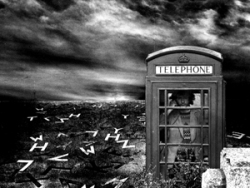
LSD-inspired photomontage described in Chapter 17 of The Mad Artist
My Latest Novel

 Musings of the Mad Artist